
Ballot Question 7: What Building Inspectors Should Know Before November 3

How a statewide minimum lot size for single-family homes would reach zoning enforcement and permit volume in towns with public water and sewer

Autumn aerial view of a Massachusetts neighborhood street with translucent 3D outlines of new homes and accessory dwelling units on subdivided lots
Published
Oct 27, 2026
Last Updated
Oct 27, 2026

When Massachusetts voters go to the polls on Tuesday, November 3, 2026, one statewide ballot measure could have a direct effect on the day-to-day work of building departments: Question 7, the "starter homes" measure.

At a recent association discussion, it became clear that many inspectors were not yet aware Question 7 is on the ballot. Because the measure deals with zoning, and in most Massachusetts communities the building official is also the zoning enforcement officer, it's worth every member understanding what it does before Election Day.

This post is informational only. The MBCIA is not taking a position for or against Question 7. Our goal is simply to make sure members are aware of the measure and how it could affect their departments. Vote however you see fit.

What Question 7 does

Question 7 would create the state's first statewide minimum lot-size standard for single-family homes. It amends the state Zoning Act (M.G.L. c. 40A) so that a local zoning bylaw could not prohibit, unreasonably restrict, or require a special permit or other discretionary approval for a single-family home on a lot that meets all three of the following conditions:
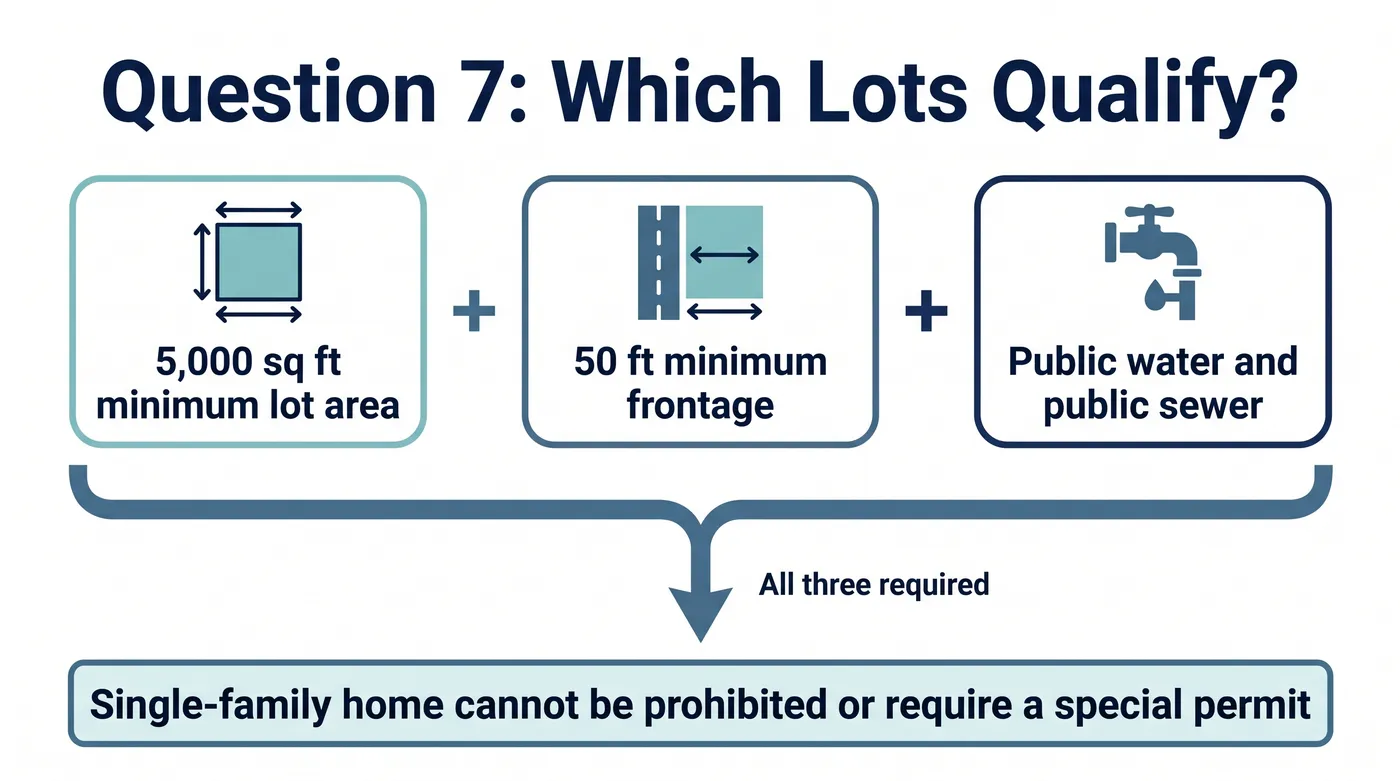
  • at least 5,000 square feet of lot area,
  • at least 50 feet of frontage, and
  • access to public water and public sewer.
Infographic showing that a lot must meet all three conditions under Question 7: 5,000 square feet of lot area, 50 feet of frontage, and public water and sewer

The measure applies only to single-family homes, not to townhouses or multifamily buildings. If approved, it would take effect approximately 30 days after the election, and the Executive Office of Housing and Livable Communities (EOHLC) would be responsible for writing and enforcing the implementing regulations.

What stays under local control

The measure does not eliminate all local authority. Communities could still apply reasonable regulations to qualifying homes, including:

  • building setbacks,
  • height and bulk,
  • open space requirements,
  • parking requirements, and
  • short-term rental restrictions.

What a municipality could not do on a qualifying lot is require a larger minimum lot size or frontage, or require a special permit or other discretionary zoning approval.
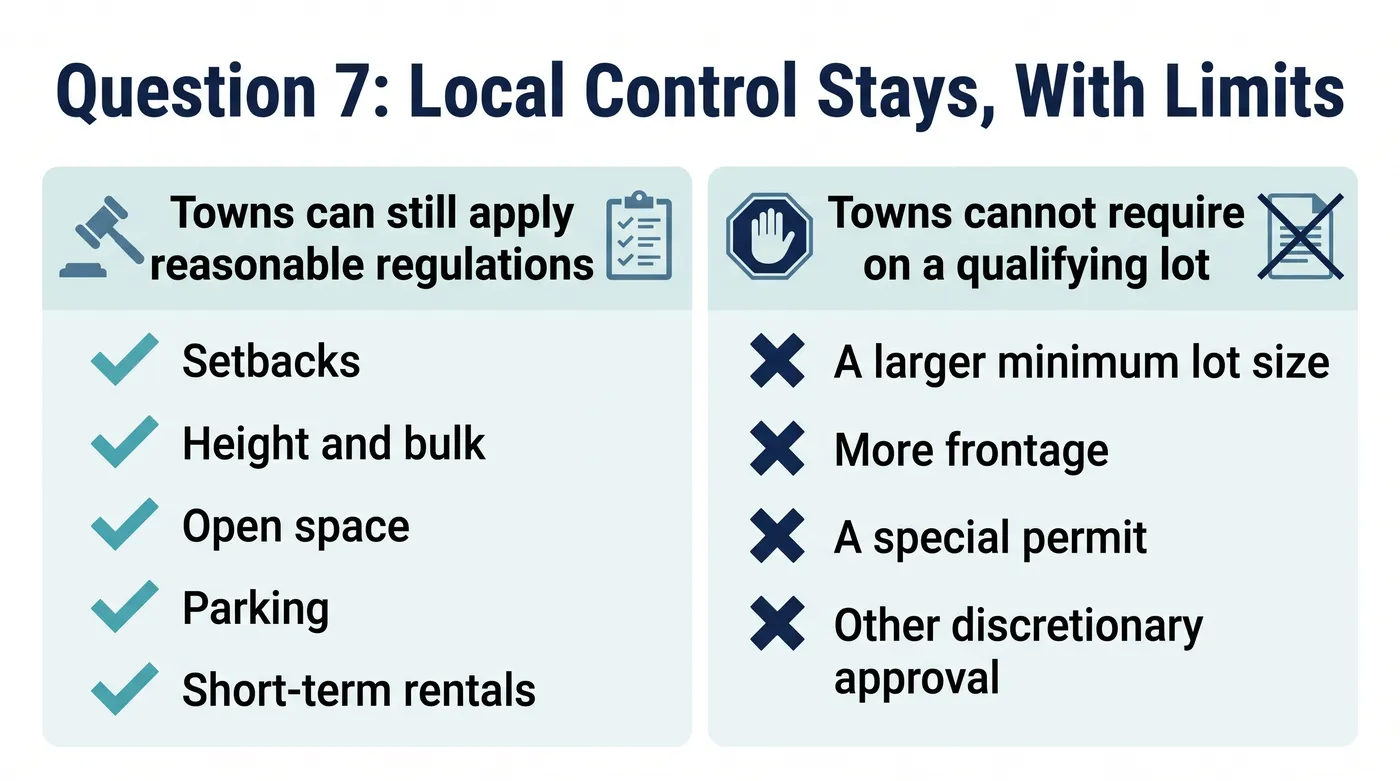
Infographic comparing what towns can still regulate under Question 7 with what they cannot require on a qualifying lot

One term to watch: the measure does not define "unreasonably restrict" or "reasonable regulations." Where a local dimensional rule falls on that line is expected to be shaped first by EOHLC guidance and, eventually, by the courts.

Why it matters for building inspectors

Even though Question 7 is framed as a housing measure, its practical effects land squarely in the building department:

  • Zoning enforcement runs through your office. In most Massachusetts municipalities, the building commissioner or inspector also serves as the zoning enforcement officer under M.G.L. c. 40A, § 7. A change to the zoning floor is therefore a change to what your office administers and enforces.
  • A shift from discretionary review to by-right. By barring special permits and other discretionary approvals for qualifying lots, the measure moves these projects out of the special-permit / board-review track and into as-of-right permitting. More of the compliance determination falls to the building official applying the dimensional rules that remain, rather than to a board weighing a discretionary application.
  • Potential increase in lots and permit volume. Because the standard drops to 5,000 square feet and 50 feet of frontage on sewered-and-watered land, a single parcel that is one buildable lot under current zoning could, depending on its size and frontage, be divided into several conforming lots. That can translate into more applications, plan review, inspections, and certificates of occupancy, in departments that are often already short-staffed.
  • It arrives alongside the ADU changes. Question 7 would take effect while departments are still absorbing the recent statewide accessory dwelling unit (ADU) provisions. Members should think through how the two interact on a given lot.
  • Public water and sewer is the dividing line. The measure applies only where there is both public water and public sewer. Communities served by private wells and septic systems would generally fall outside it, while communities with municipal water and sewer would see the change. This also raises local infrastructure-capacity questions that building and health officials routinely field.
  • Administrative follow-on work. New lots can mean new addressing, reconciling the statewide standard against existing local bylaws, and digesting EOHLC's regulations once they are issued.

Regardless of how one feels about additional housing, Question 7 is a zoning change, and in Massachusetts zoning enforcement flows through the building department. If your community has public water and sewer, it affects your office.

A few things to keep straight

  • Don't confuse it with the existing program. There is a separate, voluntary "Starter Home Zoning Districts" program under Chapter 40Y (760 CMR 69) whose regulations are already in effect. Question 7 is a different, mandatory statewide standard.
  • Projected impact is debated. The ballot campaign estimates roughly 2,200–5,700 net new homes per year statewide; Tufts University's nonpartisan Center for State Policy Analysis estimates far fewer (on the order of several hundred to about 1,200 per year) and notes the measure does not by itself guarantee that homes get built or that they will be "starter-sized."

The bottom line

Question 7 is on the statewide ballot on November 3, 2026. Whatever your view, take a few minutes before Election Day to understand it, and if it passes, be ready for how it may change permitting and zoning administration in communities served by public water and sewer.

Further reading

The MBCIA provides this summary for member awareness only and takes no position on Question 7.

The information shared by the Massachusetts Building Commissioners & Inspectors Association (MBCIA) is intended to enhance knowledge of building safety within Massachusetts. Recommendations provided are for educational purposes only and do not constitute legal or professional advice. MBCIA holds no liability for actions taken based on this information. Always consult with relevant regulatory entities and professionals for specific advice or guidance.

Signup For Our Newsletter

Be The First To Know The Latest Building Official News

Stay updated with the latest industry trends, building code updates, and news from MBCIA. Subscribe to our newsletter and be the first to know about essential insights and events.

Thank you! Your submission has been received!
Oops! Something went wrong while submitting the form.
By submitting this form means you agree to MBCIA's Privacy Policy and Terms & Conditions. By entering your mobile number, you agree to receive texts from MBCIA about events, dues, and announcements. Msg & data rates may apply. Reply STOP to opt out. Terms | Privacy