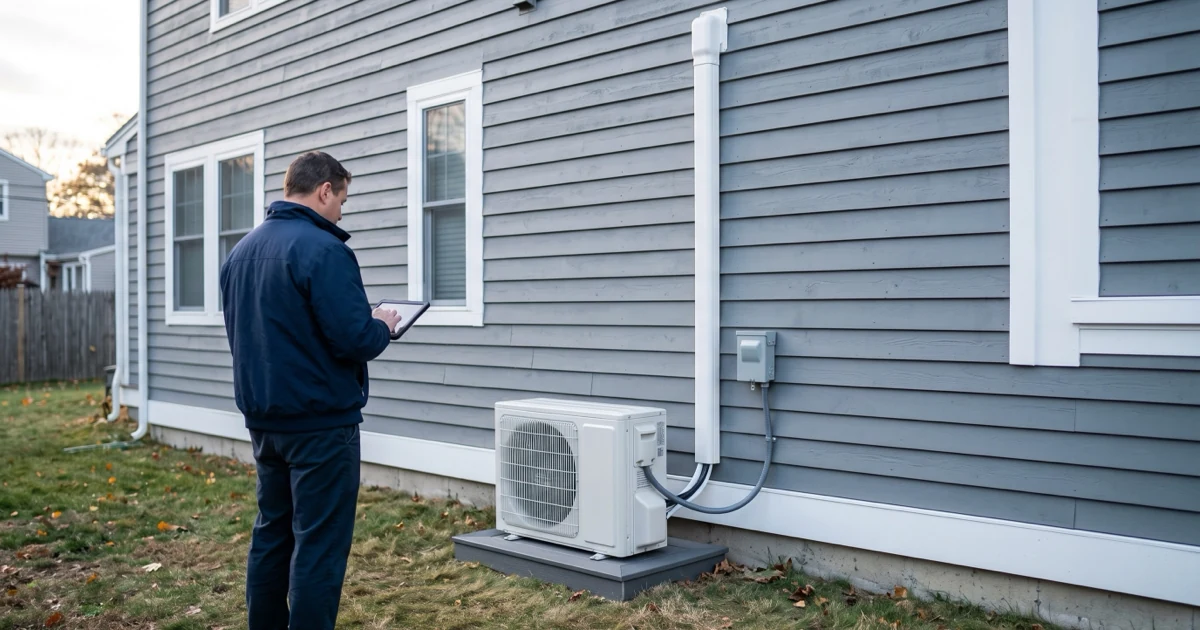
Ductless mini-splits have gone from an occasional retrofit to one of the highest-volume residential jobs in the Commonwealth, and departments have been answering the permit question inconsistently for years. OPSI settled it. The short version: a standalone mini-split retrofit in a one- or two-family dwelling does require a building permit, and a construction supervisor license is not required for the most basic installation but is required once the work involves cutting or notching building elements.
This post walks the reasoning OPSI used to get there, because the reasoning is what lets you defend the answer to a contractor who has been doing it the other way for a decade, and it covers the questions the guidance deliberately leaves open.
Scope first, because it is narrower than the title suggests.
The guidance addresses standalone installations in one- and two-family dwellings. It expressly does not cover installations that are part of new construction or of a larger renovation, where the mini-split falls under the building permit already issued for that other work.
That distinction resolves a lot of counter arguments before they start. If a mini-split shows up in a whole-house renovation package, this guidance is not the document to reach for.
OPSI also states its own limit: the goal is consistent application across the Commonwealth, while recognizing that the building official having jurisdiction must make individual determinations based on the specific facts before them. DOL and OPSI publish these documents as guidance resources, not as official interpretations or directives, and each building official remains responsible for enforcement within their jurisdiction.
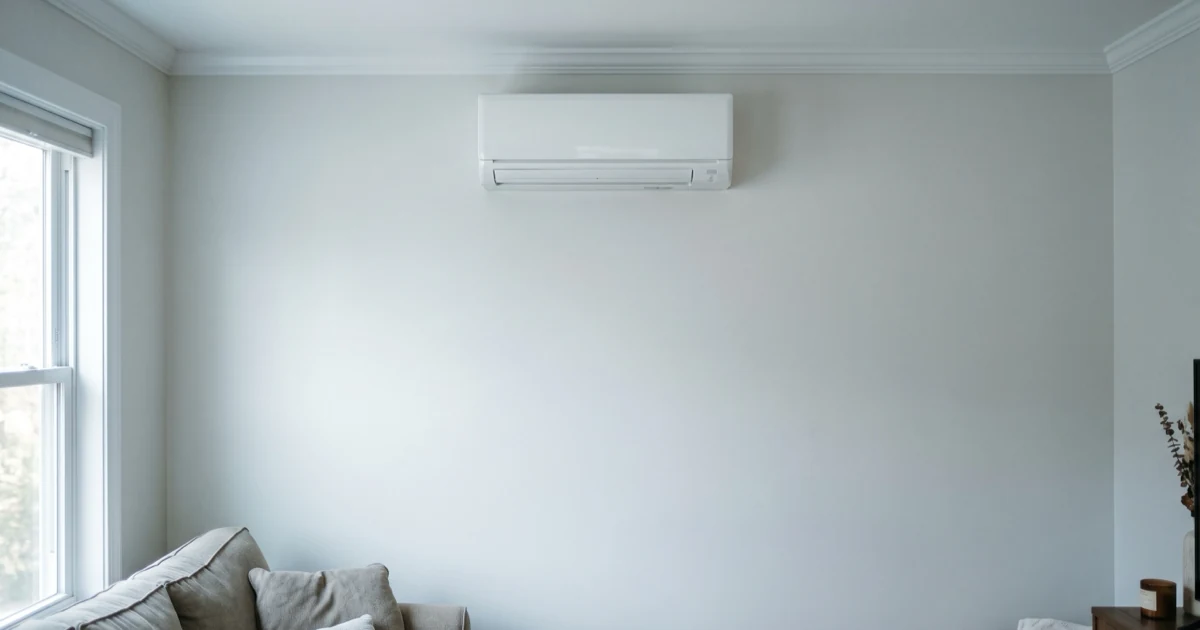
The 780 CMR Residential Code does not define a ductless mini-split, so the definition comes from the 2021 International Mechanical Code, Section 202: a heating and cooling system comprising one or multiple indoor evaporator or air-handling units and an outdoor condensing unit, connected by refrigerant piping and electrical wiring, capable of cooling or heating one or more rooms without traditional ductwork.
Why the IMC definition and not the broader heat pump definition already in 780 CMR Residential R202? Because 780 CMR Residential R201.3, Terms Defined in Other Codes, directs that where a term is not defined in 780 CMR Residential, the meaning ascribed in other ICC publications applies. The IMC definition is more specific to the actual system, and it enumerates components the residential code does not. That enumeration is what carries the analysis.
The chain runs through five steps, and it is worth knowing all five because a contractor will usually challenge one of them.
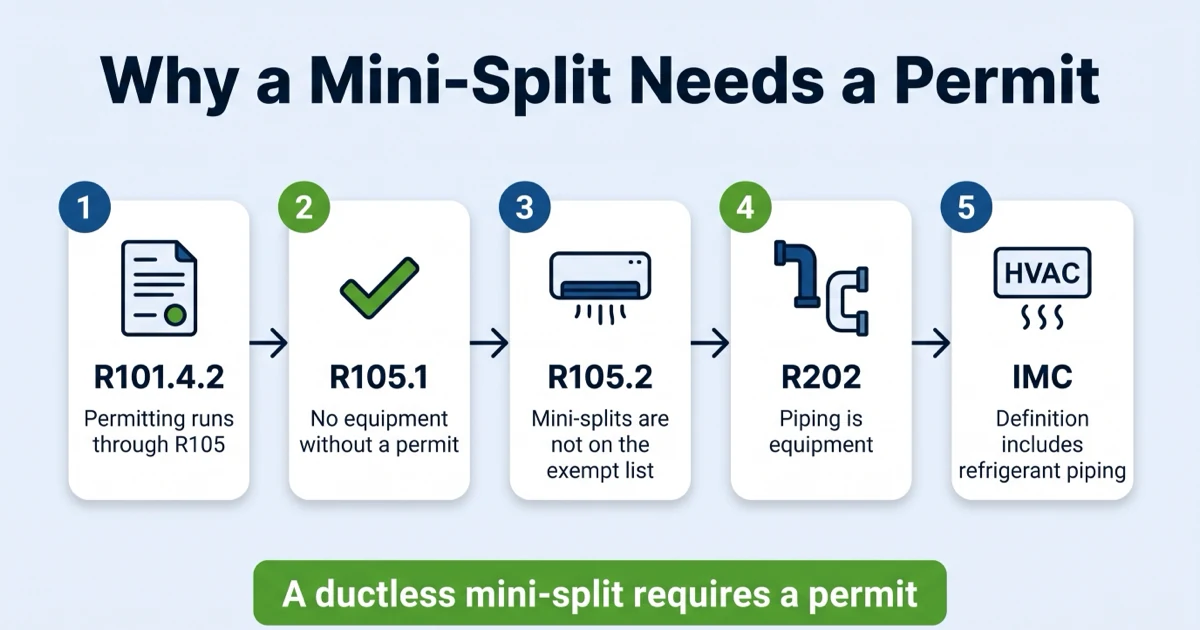
Step one. 780 CMR Residential R101.4.2, Mechanical, adopts the 2021 IMC for mechanical systems, but adopts only Sections 101 and 102 of IMC Chapter 1. The rest of IMC Chapter 1, which is where the IMC’s own permitting provisions live, is not adopted. Permitting therefore runs through 780 CMR Residential R105, not the IMC. The same section contains a carve-out worth noting: the adoption does not apply to work governed by the Specialized Codes under M.G.L. c. 143, § 96, including sheet metal work as defined in M.G.L. c. 112, § 237.
Step two. 780 CMR Residential R105.1, Required, makes it unlawful to install or alter any equipment regulated by 780 CMR without first filing an application with the building official and obtaining a permit.
Step three. R105.2, Work Exempt from Permit, does not list mini-split systems.
Step four. R202 defines a mechanical system as a system specifically addressed and regulated in the code, composed of components, devices, appliances, and equipment. Equipment is defined to include piping, ducts, vents, control devices, and other components permanently installed and integrated to provide control of environmental conditions.
Step five. The IMC definition of a ductless mini-split explicitly includes refrigerant piping. Piping is not defined in 780 CMR Residential R202, so the IMC definition applies again: piping means pipe or tubing or both, with tubing including semirigid copper, copper-alloy, aluminum, plastic, or steel conduit.
Refrigerant piping is piping. Piping is equipment. Equipment requires a permit. A ductless mini-split system requires a permit.
A note on exceptions. The permit requirement above is the default, not an absolute. 780 CMR Residential R105.2, Work Exempt from Permit, lists work that does not require a permit, and the OPSI guidance does not override it. R105.2 does not list mini-splits, which is why the guidance lands on a permit for a standalone retrofit, but an installation that falls within a listed exemption does not need one. An exemption never authorizes work that violates the code, and the building official makes the call on the facts of each job.
This is the answer most contractors want, and it is more permissive than many departments have been applying.
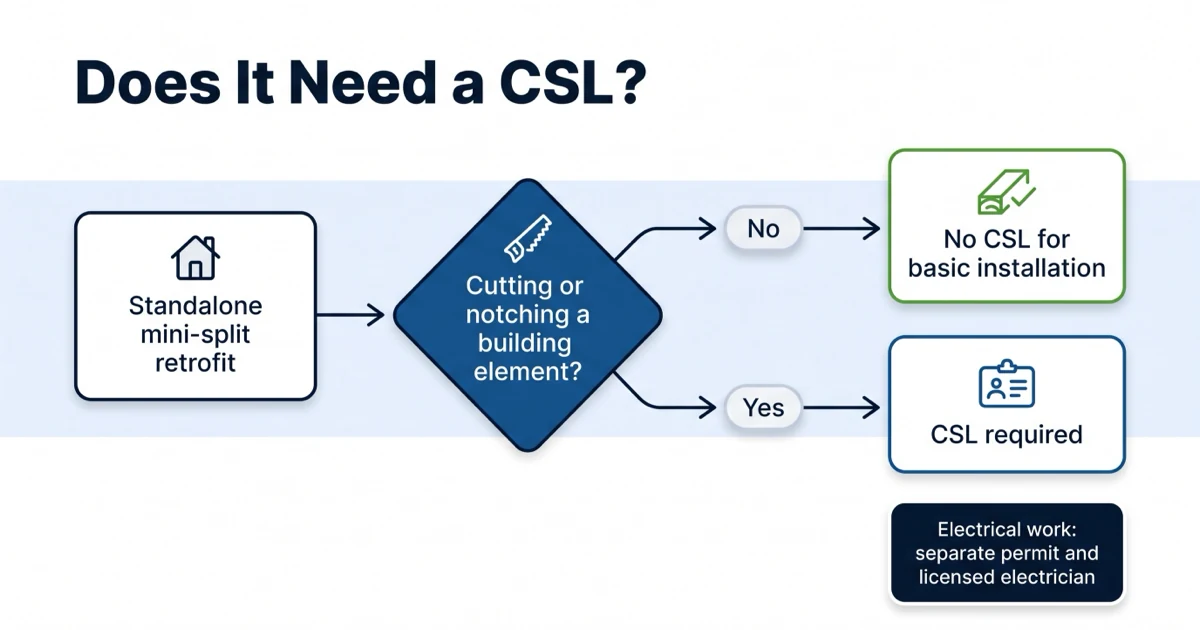
A construction supervisor license is not required for the most basic installation, but is required if cutting or notching of building elements is required.
The basis is 780 CMR Residential 110.R5.1.3, Scope, which requires licensure for individuals supervising persons engaged in construction, reconstruction, alteration, repair, removal, or demolition involving activity regulated by 780 CMR. As OPSI notes, the installation of equipment is not listed within the types of work requiring a license.
So the practical test at your counter is a structural one. A line set run through an existing penetration, with the equipment set and connected, is equipment installation. Once a joist gets notched or a structural member gets cut to route the line set, the work has moved into alteration and the CSL requirement attaches.
That is a question your inspector can answer in the field better than your intake clerk can answer at the desk, which argues for asking it on the application rather than discovering it at inspection.
Three things sit outside this document, and departments should not read silence as permission.
Electrical work is separate. A mini-split is connected by electrical wiring, and that work is governed by the electrical code with its own permit and its own licensed trade. The OPSI guidance addresses the building permit and the CSL question. It does not eliminate the electrical permit or the requirement that the electrical connection be made by a licensed electrician.
Refrigerant handling has its own licensing regime. A Massachusetts refrigeration license is required for installing, repairing, replacing, or maintaining any refrigerant-containing part of a refrigeration or air conditioning system of ten tons or more. Residential mini-splits are typically well under that threshold, so the license generally is not triggered on a house, but the threshold is worth knowing before you assert either way on a larger installation. Federal refrigerant handling certification is a separate matter entirely and is not a building department concern.
Sheet metal work is outside the IMC adoption. Per the R101.4.2 carve-out, sheet metal work as defined in M.G.L. c. 112, § 237 is governed by the Specialized Codes and 271 CMR, not by the IMC adoption. A genuinely ductless system generally does not raise this, but ducted mini-split variants exist, and the moment ductwork appears, a different regulatory track opens.
Volume. Mass Save incentives and federal tax credits have driven a sustained heat pump retrofit wave, and standalone mini-split retrofits are the most common form that wave takes in existing housing stock. A department applying a stricter rule than the state’s guidance is turning away compliant work and pushing installations underground. A department applying a looser rule is issuing no permit at all on equipment the code says requires one, and losing the inspection record along with it.
Consistency across 351 jurisdictions is exactly the problem OPSI wrote this document to address.
Four questions convert this guidance into a workable counter process:
If your department has been landing on a different answer than the one OPSI reached, or you are seeing edge cases the guidance does not cover, bring them to the next MBCIA meeting. Consistency across jurisdictions is the whole point, and it starts with departments comparing notes.
This article is for general information and does not constitute legal advice. OPSI publishes its guidance documents as resources rather than official interpretations, and each building official is responsible for enforcement of 780 CMR within their own jurisdiction.
The information shared by the Massachusetts Building Commissioners & Inspectors Association (MBCIA) is intended to enhance knowledge of building safety within Massachusetts. Recommendations provided are for educational purposes only and do not constitute legal or professional advice. MBCIA holds no liability for actions taken based on this information. Always consult with relevant regulatory entities and professionals for specific advice or guidance.
Stay updated with the latest industry trends, building code updates, and news from MBCIA. Subscribe to our newsletter and be the first to know about essential insights and events.


