
Hoarding calls are among the hardest a building department fields, and the standard enforcement playbook usually makes them worse. The short version: hoarding cases sit at the intersection of the building code, the sanitary code, and the fire code, they almost always involve a resident living with a recognized mental health condition, and the departments that get durable results are the ones that coordinate with health and housing partners instead of going straight to condemnation. This post walks through the legal framework, a field protocol, and the multi-agency model that Massachusetts communities are using, and it points you to the hoarding information file now available in the MBCIA resource section.
A typical violation has a fix: repair the railing, clear the exit, restore the heat. Hoarding is different because the condition of the property and the wellbeing of the person are the same problem. Hoarding disorder is recognized as a distinct mental health condition, and research compiled by Metro Housing Boston found that forced cleanouts, on their own, have extremely high recurrence rates. The clutter returns, often within months, and the resident is now afraid to open the door to anyone with a badge or a clipboard.
That matters for enforcement strategy. An order that treats the accumulation as ordinary rubbish invites a cycle of cleanout, recurrence, and escalating cost to the municipality. An approach that pairs enforcement authority with mental health and housing support is slower on paper but far more likely to produce a home that stays safe.
The scale of the issue is larger than most departments assume. The International OCD Foundation’s Hoarding Center estimates that hoarding disorder affects 2 to 4 percent of the population, and hoarding behavior is markedly more common among older adults. Every jurisdiction has these homes, whether or not they have surfaced as complaints yet, which is the strongest argument for building your protocol before the next call rather than after it.
None of this changes your core duty. Blocked egress, compromised structural loading, and ignition hazards are real risks to the occupant, to neighbors in attached buildings, and to the firefighters who may have to enter that structure. The playbook below is about sequencing your authority so the safety problem actually gets solved.
Three regulatory tracks can be in play at once, and knowing which one carries the case determines who leads.
The building code. The Massachusetts State Building Code (780 CMR) governs when accumulation creates structural concerns, such as floor loading from dense storage, damaged systems hidden behind material, or conditions that render a structure unsafe. Building officials also carry the authority for posting and, in extreme cases, condemnation, which is precisely why that authority should be the last card played rather than the first.
The sanitary code. Minimum habitability standards live in 105 CMR 410, enforced by the local board of health. The sanitary code prohibits obstruction of any exit or passageway, and it assigns responsibility for keeping means of egress clear. Many hoarding conditions (blocked exits, inaccessible fixtures, pest harborage) are sanitary code violations before they are building code violations, which makes the health department a natural lead or co-lead.
The fire code. The local fire official enforces the Comprehensive Fire Safety Code (527 CMR 1.00), and hoarding conditions raise nearly every concern that code exists to address: fuel load, blocked egress, inaccessible utilities, and delayed rescue. Fire departments also want to know about heavy-content structures before an incident, not during one. Flagging known hoarding addresses for responding crews is one of the most valuable things an inspector can do.
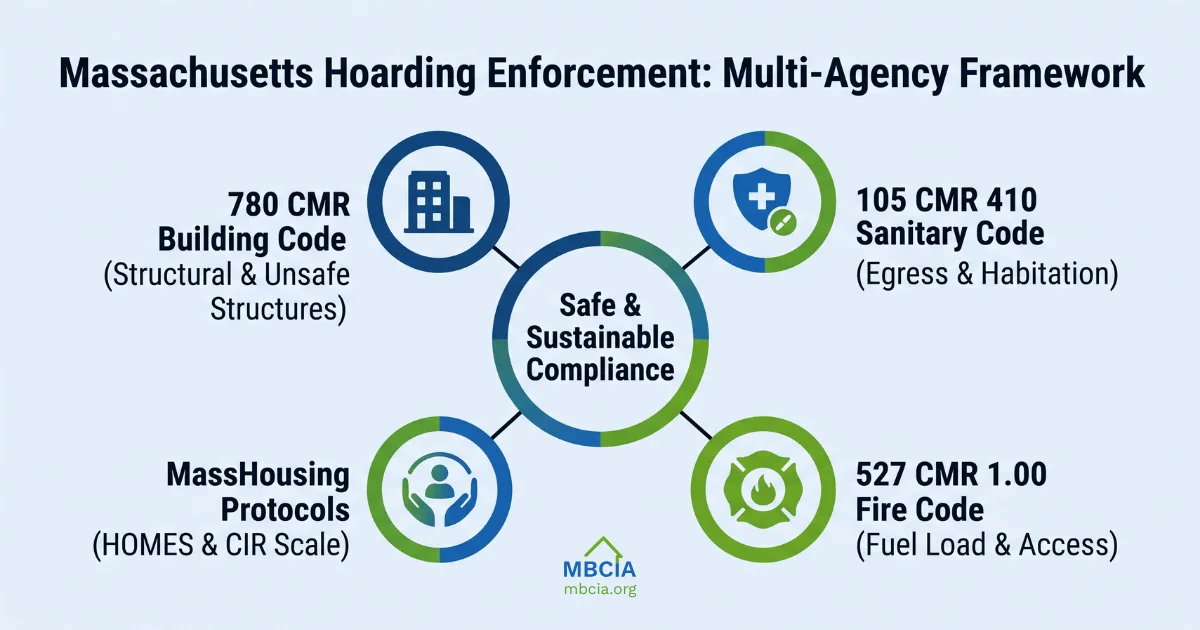
The communities handling hoarding well are not improvising case by case. They use a standing multi-agency structure, usually called a hoarding task force or response network, that brings inspectional services, the board of health, fire, aging services, and mental health providers to the same table.
Boston’s Inspectional Services Department runs a coordinated response through its hoarding program, working alongside a task force that draws on more than a dozen city departments and agencies. Smaller communities do not need Boston’s scale to copy the model: a quarterly meeting between the building department, health agent, fire prevention officer, and a regional mental health contact is enough to start.
Statewide, MassHousing’s hoarding resources are the best single collection for Massachusetts officials. It includes the Hoarding Best Practices Guide, code enforcement protocols developed with Metropolitan Boston Housing Partnership, the HOMES multi-disciplinary hoarding risk assessment, a uniform inspection checklist, and the Massachusetts Hoarding Resources Directory for finding mental health services and cleanup assistance in your region. If you build your local protocol on any foundation, build it on these documents.
Refused entry is the single most common obstacle in hoarding cases, and it is where enforcement actions most often go legally wrong. Absent an emergency, an inspector needs either the occupant’s consent or an administrative inspection warrant to enter a dwelling, and pushing past a reluctant resident can compromise the entire case. If conditions visible from the exterior, reports from family, or a first visit justify concern but the door stays closed, document the basis for that concern and work with municipal counsel on a warrant application rather than forcing the issue.
Two practical notes. First, consent obtained through patience is better than a warrant: a second or third knock accompanied by a social worker or a familiar figure such as a council on aging outreach worker succeeds surprisingly often. Second, in a genuine emergency (visible structural failure, fire in progress, a medical crisis inside) emergency access authority applies as it would in any other structure, but the threshold is immediate danger, not accumulated frustration with a non-compliant occupant.
A workable field protocol looks like this:

Certain situations inside a hoarded home trigger referrals beyond the usual code partners, and knowing them in advance keeps a hard visit from becoming a missed one:
Sometimes it is. Immediate threats to life safety, refusal of all engagement over a sustained period, or conditions endangering abutters can require emergency orders, court involvement, or condemnation. The playbook does not remove those tools; it sequences them. Escalation undertaken after documented, staged orders and coordinated outreach stands on far stronger legal ground, and it is far more defensible to a judge who will want to see that the municipality tried proportionate measures first.
Keep two principles in view even at the enforcement end of the spectrum. Displacement is a serious harm, particularly for elderly residents, so condemnation should be reserved for genuinely unsafe structures. And a cleanout without a support plan is a temporary fix; budget your department’s effort accordingly.
MBCIA members can download the hoarding information file, including the MassHousing best practices guide, directly from the resource section. Keep it in the truck. The next hoarding call is coming, and the difference between a case that resolves and a case that cycles for years is usually the first visit.
This article is for informational purposes and does not constitute legal or medical advice. Consult municipal counsel on enforcement actions and refer residents to qualified health professionals for support services.
The information shared by the Massachusetts Building Commissioners & Inspectors Association (MBCIA) is intended to enhance knowledge of building safety within Massachusetts. Recommendations provided are for educational purposes only and do not constitute legal or professional advice. MBCIA holds no liability for actions taken based on this information. Always consult with relevant regulatory entities and professionals for specific advice or guidance.
Stay updated with the latest industry trends, building code updates, and news from MBCIA. Subscribe to our newsletter and be the first to know about essential insights and events.


