
Large Building Energy Reporting is an owner obligation. Building departments do not administer it, do not enforce it, and are not named anywhere in the regulation. The short version: buildings of 20,000 square feet or more report annual energy usage to the Department of Energy Resources, utilities report the metered portion, owners report everything else, and failure to report carries a fine of up to $150 per day. So why does it belong in a post written for building officials? Two reasons. DOER builds the Covered Buildings List from municipal assessor data, and a newly constructed building lands on that list because of a certificate of occupancy your department issued.
This post covers what 225 CMR 27.00 requires, the full calendar of deadlines, what the penalties actually are, and what to say when an owner calls your department instead of DOER.
An Act Driving Clean Energy and Offshore Wind, the Acts of 2022 chapter 179, inserted M.G.L. c. 25A, § 20, directing DOER to implement a program requiring energy use reporting for buildings over 20,000 square feet. The law took effect July 1, 2024.
DOER promulgated 225 CMR 27.00, Building Energy Reporting, on February 28, 2025, published at Massachusetts Register #1542. Regulatory authority sits at M.G.L. c. 25A, §§ 20 and 6.
A Large Building is a building on one or more parcels with a gross floor area equal to or greater than 20,000 square feet, measured to the external face of the external walls. A Covered Building is a Large Building that appears on the Covered Buildings List.
LBER sits alongside other DOER energy initiatives MBCIA has covered, including recent updates to the Stretch and Specialized energy codes, so departments tracking one are worth tracking both.
The obligation is split three ways, which is the most common source of confusion.
Distribution companies report by May 30. Each electric, gas, and steam distribution company reports all energy usage it provided to covered buildings for the previous calendar year, at the meter level unless DOER approves an exception. Steam distribution companies additionally report the volume of steam produced by each generation source.
Municipal utilities report by May 30. Municipal lighting plants carry the same obligation directly, at the meter level, under their own reporting guideline. Departments in municipal light plant communities should know this sits with the plant, not with the town.
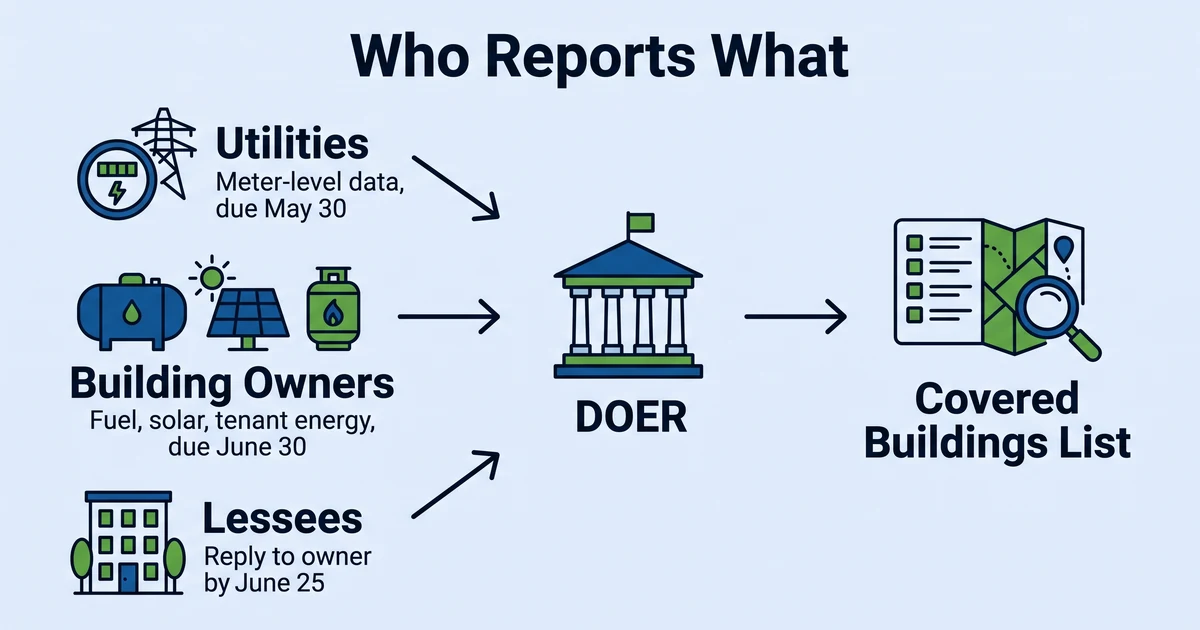
Building owners report by June 30. Owners report all energy not provided by a distribution company or municipal utility. That is on-site generation, delivered fuels such as oil, propane, and wood, and energy delivered to individual lessees and common areas in aggregate. Reporting uses Energy Star Portfolio Manager or another DOER-approved program.
The distinction matters when an owner calls. A building served entirely by a distribution company may have very little to report, because the utility already did it. A building on delivered oil almost certainly has an obligation. Owners must self-certify all data they submit.
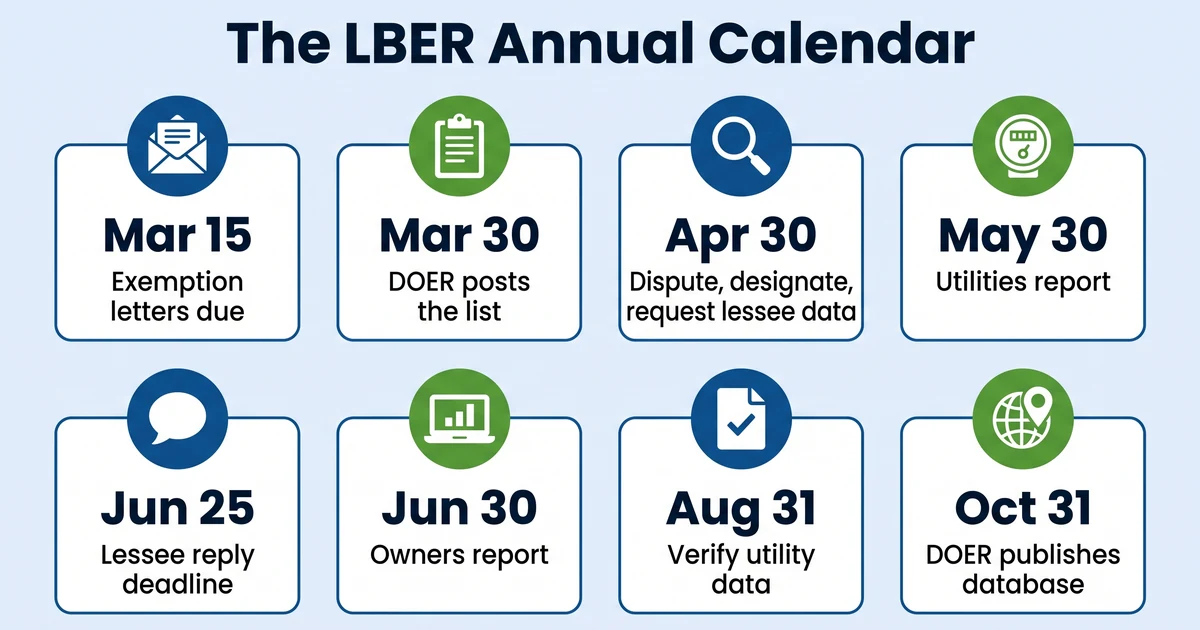
Nine dates run the program. Handing this list to an owner answers most questions before they are asked.
For Compliance Year 2025 only, the distribution company and municipal utility deadline was moved to June 30, 2025.
Two mechanisms, and the second is the one nobody expects.
The list is built from municipal assessor data. Under 225 CMR 27.03(3), DOER identifies Large Buildings using information sources that may include municipal assessor databases, MassGIS assessor data, and other state or municipal property data. That means the square footage your community’s assessor carries is what determines whether a building crosses the 20,000 square foot line. An owner who believes they have been wrongly listed is frequently describing an assessor record problem, not a DOER problem, and the fix is local.
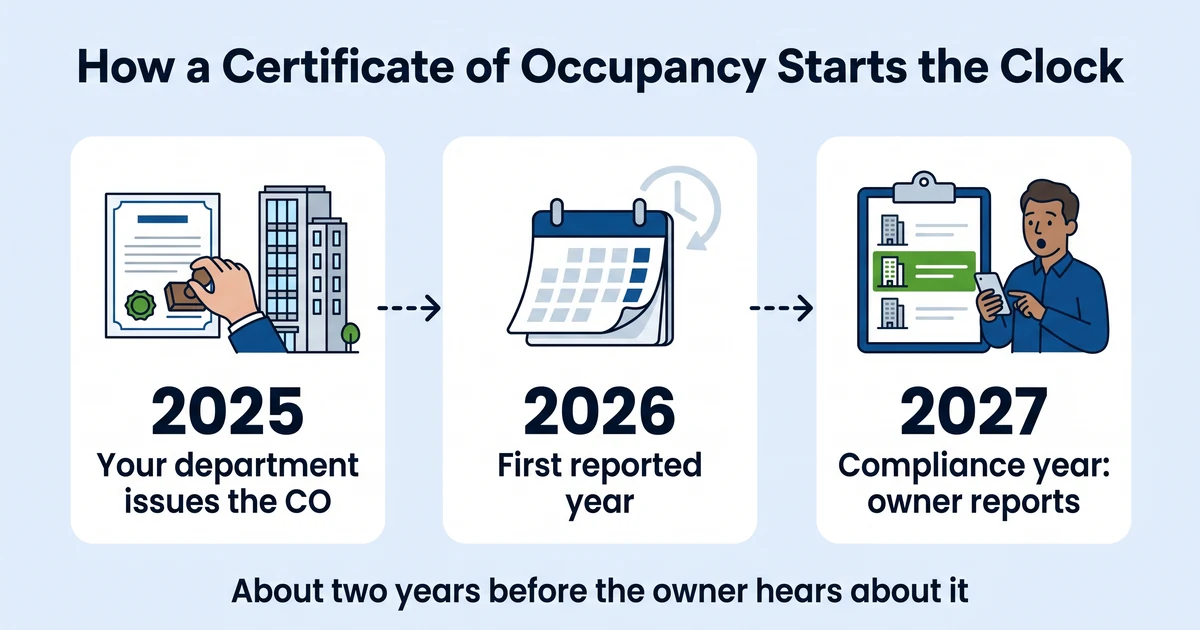
New construction enters through the certificate of occupancy. Under 27.03(2), a newly constructed building is included on the Covered Buildings List in a compliance year if the temporary certificate of occupancy or the certificate of occupancy was issued at any point prior to that compliance year’s reported year.
Unpacked: a CO issued during 2025 means calendar 2026 is the first reported year, which is reported during compliance year 2027. The document your department issues is what starts the clock, roughly two years before the owner hears about it.
Nobody is asking building officials to administer LBER, and nobody should. But the owner surprised to find their new building on the list will call the department that issued the CO before they call DOER, and a department that understands both mechanisms can resolve that call in a minute.
Confirmed against 225 CMR 27.11. The structure differs by who failed to report.
Building owners. DOER provides notice of the failure. If the owner does not submit the missing information within 30 days of that written notification, DOER may issue a fine of up to $150 per day for each day the information is not provided.
Distribution companies and municipal utilities. DOER provides notice, and the company has 30 days to respond with a plan for supplying the missing data. If it fails to respond, or within 90 days of the notice fails to make a good faith effort to progress that plan, DOER may issue a fine of up to $150 per Covered Building per day. Note the per-building multiplier, which does not apply to owners.
Lessees. A lessee occupying more than 5% of a covered building’s gross floor area that fails to respond within 30 days to an owner’s written request for usage information can itself be fined up to $150 per day after notice and a further 30 days.
One protection worth knowing. An owner may not pass a fine through to a lessee occupying less than 5% of the building’s gross floor area.
And one safe harbor. An owner is not penalized for failing to report energy ordered by, delivered to, and charged directly to a lessee, provided the owner sent a written request for that information to the lessee no later than April 30, received no response by June 25, and gives DOER evidence of the request. Owners with triple-net tenants should have that request going out every April as a matter of routine.
DOER may audit the accuracy of submitted information for the five calendar years following a reported year, and may request whatever information it determines necessary to monitor compliance. On reasonable notice, it may conduct audits including inspection and copying of records and site visits to the building.
Under 225 CMR 27.05(1), a covered building does not need to report if:
The exemption is not automatic. The owner submits a letter to DOER by March 15 of the compliance year identifying which criterion applies with supporting documentation, and DOER removes exempted buildings before the March 30 publication. Miss March 15 and the building appears on the published list.
DOER may also issue a guideline identifying building uses that are exempt under the catch-all provision.
Separately, buildings already reporting under Boston’s Building Emissions Reduction and Disclosure Ordinance, Cambridge’s Building Energy Use Disclosure Ordinance, or another approved municipal ordinance may satisfy the state obligation by submitting the same information to DOER. No double reporting.
Worth knowing because it comes up at permitting. If DOER is not notified of an ownership change in the form 27.06 requires, all compliance obligations remain with the owner listed on the Covered Buildings List. The seller stays liable until the paperwork is done.
There is also a distinction between two kinds of designation that owners routinely conflate. Designating a third party as Building Owner transfers full responsibility, including penalties, and the designee must sign accepting it. Designating a third party as Reporting Entity transfers only the act of reporting. Responsibility for compliance and any penalties stays with the owner. A property manager who agrees to “handle the reporting” has usually agreed to the second, not the first.
By October 31 each year, DOER publishes energy use information and the associated greenhouse gas emissions for every covered building. It goes up in database format, fully text-searchable and sortable by municipality, zip code, and every data element, and it is also published in map format. DOER additionally publishes an annual comprehensive report on large building energy usage.
Personally identifying information about owners and lessees is excluded from published reports and is not a public record, though aggregates are. An owner’s business name and business address are not treated as personally identifying information.
So the honest answer to the owner asking what happens to their numbers: they go on a public, searchable, sortable map with an emissions figure attached.
Worth saying plainly, because owners assume the worst. LBER is a reporting program. It sets no energy performance target, requires no efficiency improvements, and imposes no compliance trajectory. During rulemaking, commenters urged DOER to adopt building performance standards with phased milestones, and the final regulation did not do it.
Actual energy-performance requirements for large buildings run through the Massachusetts Base Energy Code for commercial buildings and the ASHRAE 90.1 energy standard it incorporates by reference, not through LBER.
That is a meaningful distinction from a Boston-style emissions cap, and owners deserve to hear it. They also deserve to hear that publication of a mapped emissions profile is exactly the infrastructure a performance standard would need if the Legislature ever wanted one.
Do say: LBER is a state reporting program administered by DOER under 225 CMR 27.00, applying to buildings of 20,000 square feet or more. Coverage is determined by DOER’s Covered Buildings List. Owners claim buildings and report through the MassBEAM portal. Disputes, exemption letters, and extension requests all go to DOER, each with its own deadline.
Do say, if the complaint is about square footage: the list is built partly from assessor data, and the assessor’s office is worth a call.
Do not say: whether their particular building is covered, whether an exemption applies, or what they owe for a missed deadline. Those are DOER determinations, and an informal opinion from a building official on a state energy reporting obligation is liability with no upside.
Add the two links to your department’s resource page or front-counter sheet: the Covered Buildings List and the MassBEAM portal.
Check your CO log for the last two calendar years against the 20,000 square foot line, so you know which owners will be calling.
Talk to your assessor. If the square footage in the assessor database is wrong, the Covered Buildings List built from it is wrong too, and your department will hear about it first.
If your community is seeing the same LBER questions come across the counter, that is worth comparing notes on. Bring it to the next MBCIA meeting so departments can settle on a consistent answer.
This article is for general information and does not constitute legal advice. Reporting obligations under 225 CMR 27.00 are determined by DOER, and owners with questions about a specific building should contact the Department directly.
The information shared by the Massachusetts Building Commissioners & Inspectors Association (MBCIA) is intended to enhance knowledge of building safety within Massachusetts. Recommendations provided are for educational purposes only and do not constitute legal or professional advice. MBCIA holds no liability for actions taken based on this information. Always consult with relevant regulatory entities and professionals for specific advice or guidance.
Stay updated with the latest industry trends, building code updates, and news from MBCIA. Subscribe to our newsletter and be the first to know about essential insights and events.


