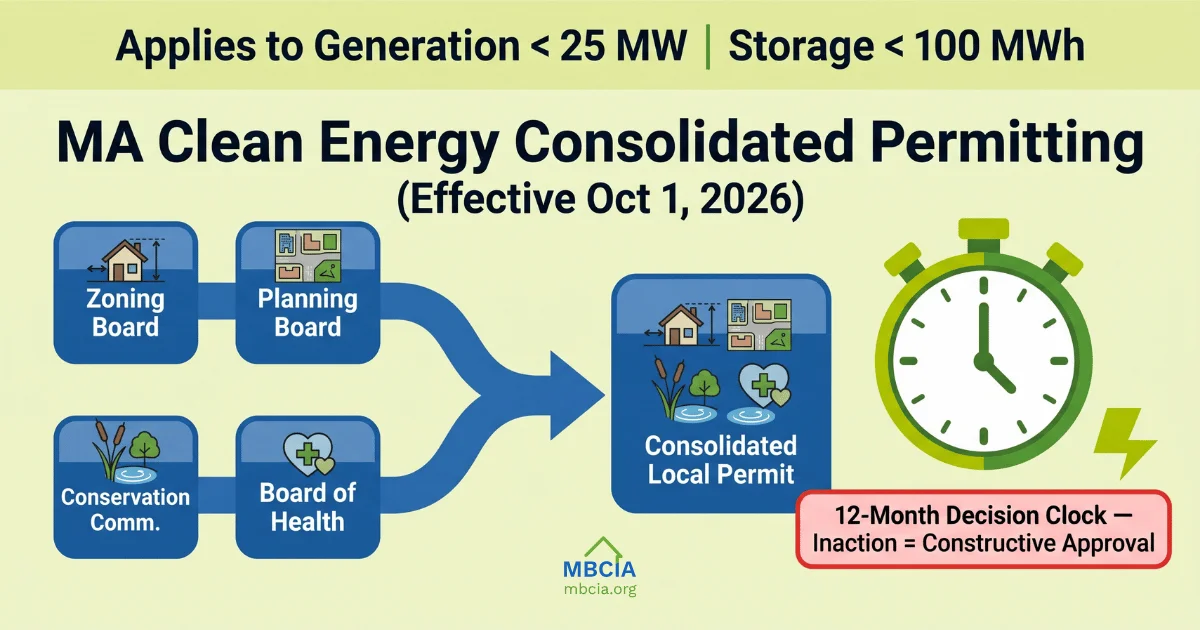
A new statewide permitting process for clean energy facilities takes effect this fall, fundamentally changing how municipalities handle these projects. The short version: beginning October 1, 2026, cities and towns must accept applications for a single consolidated local permit covering smaller clean energy projects. That permit replaces the separate local approvals that departments issue today, and a municipality that fails to decide within 12 months faces constructive approval of the application. The final regulations were announced on March 5, 2026, and the Healey-Driscoll administration’s announcement pairs the streamlined process with new community engagement requirements. This post covers what the process is, which projects it covers, and what a building department should have in place before the deadline.
The 2024 clean energy siting and permitting law directed the state to consolidate and expedite permitting for energy infrastructure and to restructure how state and local reviews are conducted. The Clean Energy Siting and Permitting Division within DOER now supports the process, and the state has published the final siting and permitting regulations along with a page that tracks the development of the reforms.
Two ideas drive the new system. First, a qualifying project receives one permit, not a stack of them: a single consolidated permit is intended to encompass the local approvals that currently come from the zoning board, planning board, conservation commission, board of health, and other local bodies. Second, review runs on a clock: 12 months for the consolidated local permit and 15 months for large projects reviewed at the state level by the Energy Facilities Siting Board.
Municipalities could begin offering the new pathway as early as July 1, 2026. Participation will no longer be optional on October 1, when every city and town must begin accepting applications under the new process.
The consolidated local permit applies to smaller facilities:
Projects at or above those thresholds go to the Energy Facilities Siting Board for a consolidated state permit, with decisions made within 15 months. The practical effect for local officials is a sorting question at intake: a proposal either belongs in your municipality’s consolidated process or in the EFSB’s, and the size thresholds determine which.
DOER issued guidelines for the new process in January 2026 covering the mechanics that matter to a permitting authority: pre-filing notices from applicants, consolidation of local reviews into a single proceeding, public participation requirements, the public health, safety, and environmental standards a project must meet, commonly expected permit conditions, and minimization and mitigation measures.
Constructive approval is the provision that deserves the most attention within a building department. If the municipality does not issue a decision on a complete application within 12 months, the permit is treated as granted. That makes calendar management a compliance function: the clock, not the meeting schedule, controls the outcome. Departments that track deadlines loosely for conventional permits will need tighter systems for these.
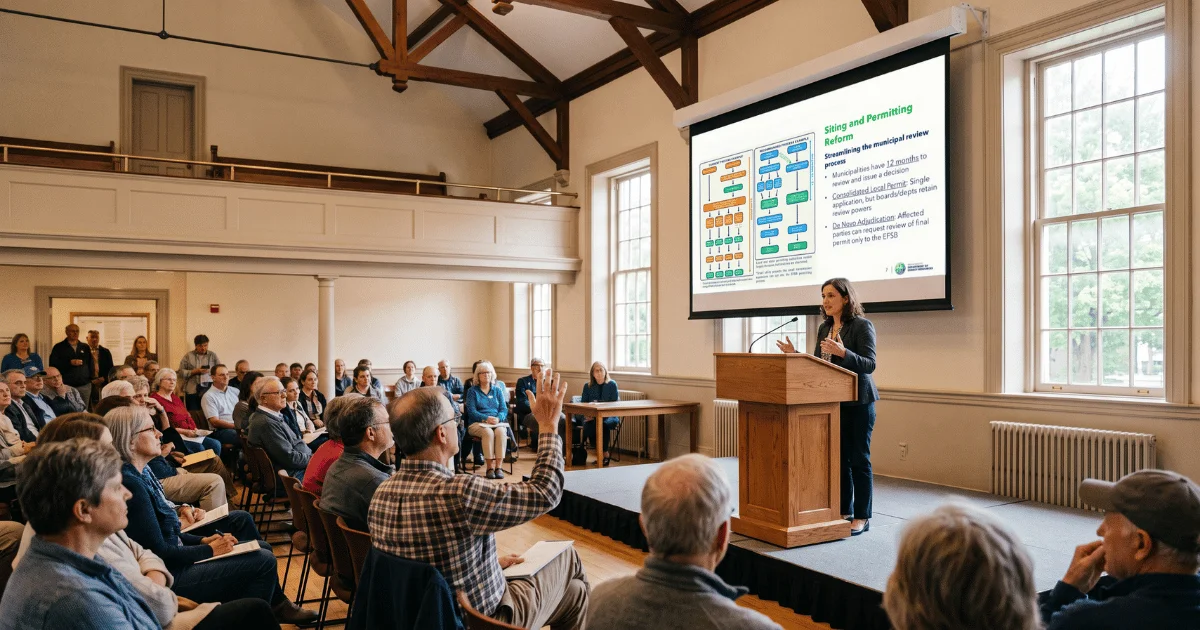
Community engagement runs alongside the timeline. The state has published guidance on community benefit plans and agreements, and the regulations include engagement requirements that the administration describes as nation-leading. Officials should understand these provisions well enough to explain to residents what participation looks like under the new process, because the venue for public input shifts when separate board hearings consolidate into a single proceeding.
Local zoning does not disappear, but it must operate within the new framework, and zoning provisions cannot be used to exclude qualifying projects from the consolidated process. DOER has developed model bylaws for solar photovoltaic and battery energy storage systems and is producing more, so communities can align their local rules with state regulations rather than discovering conflicts mid-application. The Massachusetts Municipal Association’s coverage of the final regulations is a useful plain-language summary of how the state framework and local authority fit together.
The safest posture for a community is to review its bylaws now, against both the regulations and the model language, and to fix misalignments through town meeting or city council before applications arrive, rather than after.
A readiness checklist for building departments and their municipal partners:
The Clean Energy Siting and Permitting Division is available to answer questions about the process, and DOER has been holding informational sessions for municipalities as the effective date approaches. Bring your implementation questions and what you are hearing from applicants to the next MBCIA meeting: how the first consolidated applications are handled this fall will set the patterns for other communities to follow.
This article is for general information and does not constitute legal advice. Consult municipal counsel on how the siting and permitting regulations apply to your community’s bylaws and procedures, and direct process questions to DOER’s Clean Energy Siting and Permitting Division.
The information shared by the Massachusetts Building Commissioners & Inspectors Association (MBCIA) is intended to enhance knowledge of building safety within Massachusetts. Recommendations provided are for educational purposes only and do not constitute legal or professional advice. MBCIA holds no liability for actions taken based on this information. Always consult with relevant regulatory entities and professionals for specific advice or guidance.
Stay updated with the latest industry trends, building code updates, and news from MBCIA. Subscribe to our newsletter and be the first to know about essential insights and events.


